Doorstep is a New Zealand-built platform connecting community carers, coordinators, and families around the elderly and isolated people who need them most.
New Zealand has a growing elderly population, many of them living alone. The systems designed to support them are built around compliance and billing — not human connection.
"New Zealand elder care has traditionally created systems that keep track of elderly people and the cost of care to the organisation. What hasn't been built is one that genuinely keeps our elders connected — to their community, their whānau, and their own dignity. Doorstep exists to fill this gap."
— The problem Doorstep was built to solveIt's about that peripheral awareness families used to have naturally when everyone lived closer together. Grandma was just around. You noticed if she seemed tired. You heard her laugh.
Doorstep recreates that peripheral awareness digitally, without being intrusive. Just a gentle "she's doing well this week" that lets a busy son in Auckland breathe a little easier.
Doorstep coordinates regular one-hour community visits — sitting with someone, having a cup of tea, listening to their stories — while providing careful, discrete wellbeing monitoring in the background.
Trained community carers make regular visits — not to tick boxes, but to sit and talk, share a cup of tea, and be genuinely present with someone who might otherwise spend the day alone.
Every visit captures wellbeing, mood, medications, and observations in a structured, secure way — giving coordinators and families a real picture of how someone is doing over time, not just in a crisis.
Doorstep actively links clients to local events, outings, clubs, and activities — because the goal isn't just to keep someone alive, it's to help them actually live.
A mobile-first app designed for use on the go, between visits, with one hand while carrying a bag of shopping.
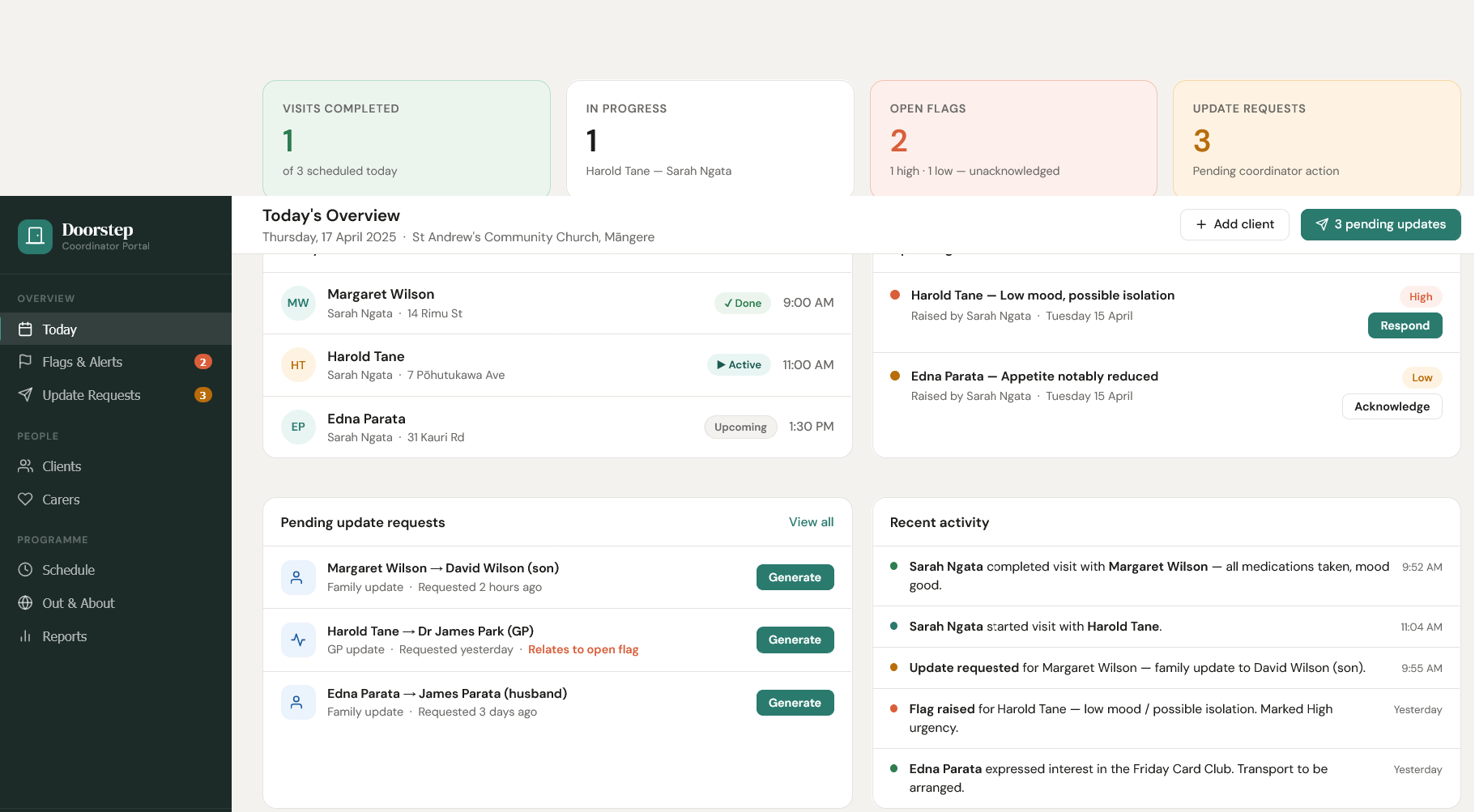
A full desktop dashboard giving the coordinator a real-time view across all clients, carers, and activity.
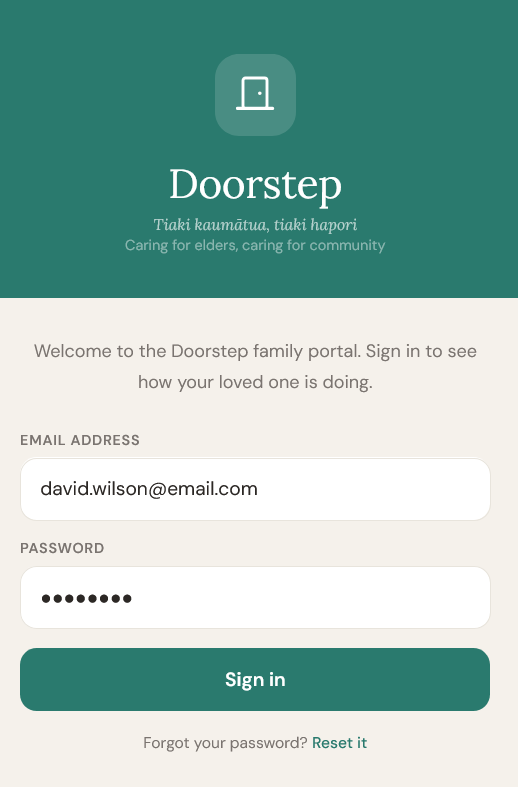
A warm portal for whānau — and a separate clinical view for GPs with SOAP notes, medication compliance and flags.
All three portals are live and running now at doorstep.nz. Use the demo login details below to explore each one.
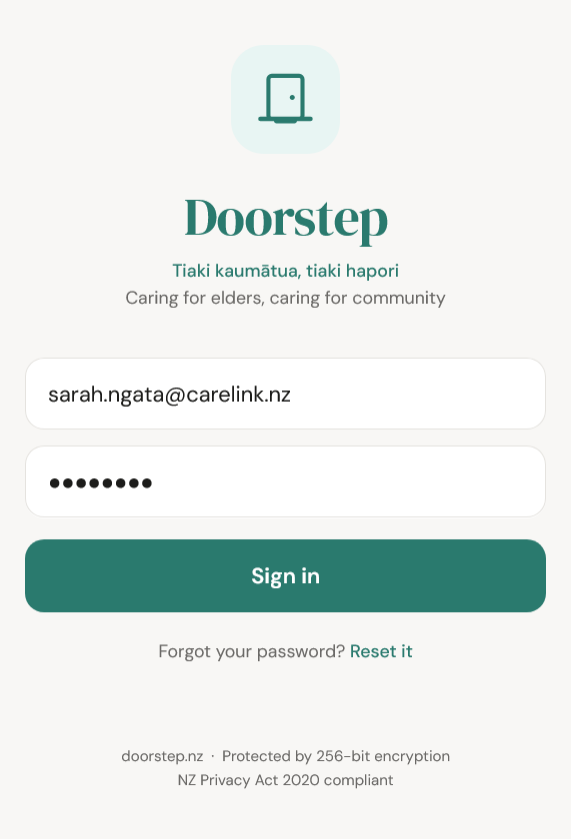
Password for all demo accounts: password
Doorstep includes a built-in testimonials system. Coordinators review and approve feedback from families, GPs and community members — then publish it automatically to their website with a single line of code.
Every feature in Doorstep was designed from a real human need — not from a feature checklist. Features marked in teal are already built into the live system.
Cultural responsiveness in Doorstep is not a policy statement — it is built into the architecture of the system itself. Every design decision reflects the reality of who our clients and carers are, and what genuine care looks like in this country.
"In Aotearoa, care is not a transaction. It is a relationship. It is manaakitanga — the expression of respect, generosity and care for others. Doorstep is built on that foundation."
Every carer profile includes a field recording their demonstrable understanding of Te Tiriti o Waitangi. This is not a tick-box — coordinators can record and verify each carer's actual knowledge and experience. Organisations can report their Te Tiriti-competent carer ratio to funders with confidence.
Clients can express a preference for a carer who shares their cultural background or speaks their language. Some kaumātua will only feel comfortable with a Māori carer who understands tikanga. Some Pacific clients want someone who shares their worldview. That is not a limitation — it is culturally responsive care done right.
Both client and carer records use Stats NZ Level 1 ethnicity classification — European, Māori, Pacific, Asian, MELAA, and Other — with support for multiple ethnicity identification. This enables meaningful equity reporting and is aligned with what DHBs, the Ministry of Health, and community funders require.
The Doorstep tagline — Tiaki kaumātua, tiaki hapori — is not decoration. The language of care is woven through the platform as a signal of values, not marketing.
The family portal is designed around the concept of whānau — that care is a collective responsibility, not an individual one. Multiple family members and trusted people can be granted access with the client's consent.
Every screen in the carer app is designed to support genuine human connection — not data entry. The visit is the purpose. The notes are the record of a relationship, not a compliance exercise.
Age and ethnicity data — universally required for NZ health funding — is captured from day one. Organisations can produce equity reports for funders, DHBs and the Ministry of Health without any additional data collection effort.
Doorstep includes a built-in directory of NZ-specific community services — Meals on Wheels, Quitline, Healthline, elder abuse reporting, transport shuttles — with one-click referral logging against the client record.
Coordinators can access Healthline (0800 611 116) directly from the flag management screen, with the client's full medical history in front of them — and log the call and outcome against the client record for safeguarding and audit purposes.
Doorstep is not just a piece of software. It is built on a set of beliefs about what care should look like in Aotearoa — and those beliefs shape every decision we make.
Doorstep handles sensitive health and personal data about some of the most vulnerable people in our community. Privacy and security are not features — they are the foundation.
Designed from the ground up to meet all Information Privacy Principles. Consent is explicit, documented, and revocable at any time.
Carers see only their assigned clients. Coordinators see their organisation. Nobody sees everything without a genuine need.
No health or personal information is ever shared with families, GPs, or anyone else without the client's explicit consent — confirmed at each request.
Production data will be hosted on NZ-based infrastructure (Catalyst Cloud). Client data stays in Aotearoa under NZ law.
Every access, edit, and data sharing event is logged immutably. Organisations can demonstrate compliance at any time.
Clients can see their own data, correct errors, withdraw consent, and have their records deleted. This is their information, not ours.
Doorstep is being built in deliberate phases — proving value at each stage before investing in the next.
This isn't a job listing. We're looking for someone who believes what we believe — that the way we treat our elders says everything about us as a community — and who wants to help build something that genuinely matters.
The right partner cares deeply about elderly people and community wellbeing. This is a mission-driven venture — commercial success follows from doing the right thing well.
We're looking for someone who can either help build the technology (development, database, infrastructure) or help grow the organisation (partnerships, funding, operations).
Relationships with churches, community trusts, DHBs, or social service organisations would be invaluable. Doorstep grows through trust — and trust comes through community.
This will not make anyone rich quickly. The pilot phase is about learning, not earning. The right partner understands that getting the foundation right creates something sustainable and significant.
If this has sparked something in you, we'd love to hear from you. Share your thoughts, your questions, or your interest in getting involved.